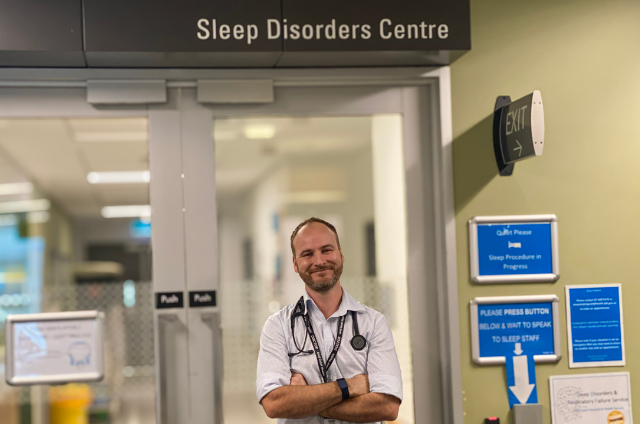
Gold Coast Health’s Sleep Medicine team is here to remind us sleep isn’t optional – it’s foundational.
Yet for many people, particularly healthcare workers with varying shift patterns, it’s the first thing to be sacrificed.
Most adults need seven to nine hours of sleep for optimal function, but in Respiratory and Sleep Physician Dr Daniel Bird’s experience, most of us are falling well below that, putting our health and wellbeing at risk.
“All the important restorative processes happen during sleep, so poor quality or insufficient sleep affects nearly everything you do,” Dr Bird said.
“I think sleep is often undervalued in modern society, particularly in high-performing environments where long hours are worn as a badge of honour.
“It is hard to expect consistently good decision-making from people who are chronically sleep deprived.”
Clinical Director of Sleep Disorders and Respiratory Failure Service (SDRFS) at Gold Coast University Hospital, Dr Bajee Krishna Sriram, is also passionate about helping others to sleep well, and has seen the service transform dramatically since he joined in 2012.
“From repurposing oncology outpatient rooms in the evening for sleep studies to the dedicated space we have now, we’ve come a long way since the department first started in 2008,” Dr Sriram said.
The team conducts gold standard, overnight type one sleep studies, monitoring brainwaves, breathing, and movement for patients with a variety of respiratory and neurological conditions.

Clinical Director of Sleep Disorders and Respiratory Failure Service Dr Bajee Krishna Sriram (L) and Senior Sleep Scientist Mr Saul McWhae (R)
Sleep apnoea – estimated to affect up to half the population – is one of the fastest-growing sleep concerns according to Dr Sriram and his team.
While home based testing of the condition is becoming more common, complex cases still rely on hospital based studies.
“We recommend continuous positive airway pressure (CPAP) therapy even for patients with mild sleep apnoea and excessive daytime sleepiness because of the profound impact it can have on quality of life,” Dr Sriram said.
“Left untreated, sleep apnoea significantly increases the risk of motor vehicle accidents and cardiovascular disease.”
He also highlights a growing gender gap.
“Men often present with tiredness or irritability, while women, especially after menopause, may present with fatigue that isn’t immediately linked to sleep apnoea,” he said.
Dr Sriram said there had been a significant breakthrough in sleep apnoea management in the form of weight loss medications.
In the United States for example, sleep clinics are changing their model to manage weight loss upfront before they treat the sleep condition, with obesity often an underlying cause.
While most common, sleep apnoea is not all SDRFS team focuses on. Narcolepsy and sleep related breathing issues linked to neuromuscular conditions are also becoming more prevalent.
Narcolepsy, which causes extreme daytime sleepiness, can be life changing once treated.
“Kids may be labelled as lazy, and adults may struggle to hold a job, so helping a patient to identify and manage the condition can transform someone’s life,” Dr Sriram said.
Dr Bird said there’s another trend which is impossible to ignore: insomnia.
“Sleep is foundational to your overall health, yet it’s often the first domino to fall,” Dr Bird said.
“It affects how you eat, exercise, connect with others, and perform at work.”
High stress lifestyles elevate cortisol, making it harder to sleep and easier to gain weight.
But according to Dr Bird, the good news is that “nothing hits as hard or as well as a good night’s sleep, and it’s well within your control”.

When it comes to shift workers, avoiding bright light after night shifts, considering melatonin as a circadian regulator, and using light therapy to re anchor your sleep cycle are all useful techniques.
For Dr Bird, the impact of their work is what makes the field so special.
“Good sleep is one of the most powerful ways to improve health and wellbeing, and when one person starts sleeping better, the whole household often feels the benefit,” he said.
“Once people get good sleep back, you can’t take it away from them.”